
There is lack of scientific basis in computing the poverty line, says govt.

A digital economy can only work with uninterrupted electricity supply. So, states now face the unpleasant task of telling their citizens that electricity rates need to be hiked. Subhomoy Bhattacharjee reports.

Daksh eServices is the fastest growing business process outsourcing services provider in India, was adjudged the most satisfying employer in the BPO sector.

Principal economic advisor, Ila Patnaik, is coordinating the work on Economic Survey 2013-14.

The substantially increased economic dualism may exert lasting negative influences which could include a reduced potential for economic growth; the persistence of a very weak employment and poverty situation; rising social and political discord; and heightened vulnerability to geopolitical challenges, cautions Shankar Acharya, former chief economic adviser to the Government of India.

'Parents, students and coaching institutes will find alternatives to cater to the demand.'
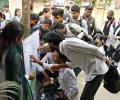
The government views dropout as a barrier to achieving the new National Education Policy's aim of 100 per cent gross enrolment rate at the school level by 2030, according to officials.

Is India witnessing jobless growth or is there actually no issue with employment? The real story is between the first two suggesting that though there is sufficient employment, the challenge is to create well-paying quality jobs, says Amitabh Kant.

Thousands of small brands are ruling the consumer market despite the predatory pricing and deep discounting by foreign e-commerce companies and efforts of certain FMCG companies to sideline the distributor network, said the Confederation of All India Traders (CAIT), which represents about 70 million traders in the country. "If the government gives support policies to non-corporate sector and tighten the e-commerce companies to obey the policy and the law both in letter and spirit, the retail trade of the country is bound to blossom in pursuance of the vision of PM Narendra Modi for Make in India and Atmnirbhar Bharat," said CAIT national president BC Bhartia and secretary general Praveen Khandelwal.

More and more women are making their presence felt in jobs related to sciences, technology, and engineering across organisations.

According to the annual HSBC 'Value of Education Learning for Life' report, India has the world's highest proportion of parents (88 per cent) who are willing to send their children abroad for higher studies, ahead of Turkey (83 per cent), Malaysia and China (82 per cent each).

The situation raises concerns about whether the promised freebies will once again push the state into a revenue deficit.

Releasing the survey report after taking into account the expert committee recommendations, Statistics Secretary Pravin Srivastava told reporter, "It is a new design and a new matrix. It would be unfair to compare it with the past. This 45- year high is your interpretation. I don't want to claim that it is 45-year low or high."

'Modi must see how we live, what we have to do to educate our children.'

These institutes, while expensive, are a viable alternative to studying abroad.

The Survey noted that while women account for almost half of India's population, their participation in labour market is almost one-third and has been declining.

With the reality of coalition politics staring the BJP in its face, this was inevitable, points out Ramesh Menon.

'Most students find it difficult to cope with the way they are expected to learn at the IITs.' 'So, all the students face the same stress.' 'But those students who are mentally weak are more affected.'

While the New Delhi Municipal Council area was given the 'Cleanest Small City' award, Uttarakhand's Gauchar was adjudged the 'Best Ganga Town' in the central government survey.

Ahead of the upcoming elections, political parties have started announcing incentives to benefit women, but what do women truly seek for genuine gender parity, asks Nivedita Mookerji.

The next government in these states may find it tough to push economic growth through long-term reforms, which would be necessary.

Ramalingam Kalirajan explains the pros and cons of both investment types.

BJP president J P Nadda on Sunday promised Uniform Civil Code (UCC) and 33 per cent reservation for women in government jobs in Himachal Pradesh while releasing the party's manifesto for the state assembly polls.
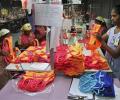
Reasons include include dropping out of education, raising children and family pressure

'What's sad today is that there are so many people who cannot find work, not because the country is devoid of that opportunity, but because we are not doing enough in the country.'

'We should not underestimate the power of Hindutva.'

A combination of one of the lowest labour costs and a large surplus workforce, which will continue to grow until 2031, is one of the key competitive edges that India is leveraging to challenge its rivals in Southeast Asia in the race for a China-Plus-One strategy. Apart from India, the countries in the race to woo global companies that manufacture in China, as well as the supply chains to their country include Thailand, Indonesia, Malaysia, the Philippines, and Vietnam. On the labour front, India is a clear winner.

That's what teachers are telling students in many Indian schools.

These firms offer job security and lucrative salries.

'Generic skills are in abundance, but technological advancements have left staple skills redundant.' 'It is why employers are now looking for alternate sources of hiring -- deploying gig workers, looking at Tier 2 and Tier 3 cities for relevant talent.'

It will be in Modi's interest to reinvent his party, read the writing on the wall that voters wrote, and move ahead. He has little choice now. The country is watching, asserts Ramesh Menon.

The size of India's middle class will nearly double to 61 per cent of its total population by 2047, from 31 per cent in 2020-21, as continuing political stability and economic reforms with a sustained annual growth rate of between 6 per cent and 7 per cent over the next two and half decades will make the country one of the largest markets in the world. The findings are part of a report released on Wednesday by the People Research on India's Consumer Economy (PRICE) and India's Citizen Environment, a not-for-profit think tank. The report titled, The Rise of India's Middle Class, is based on an analysis of primary data collected by PRICE through its pan-Indian survey.
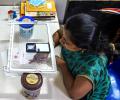
'Online teaching requires a new set of skills to be acquired by the teacher.' 'These skills are not like foot sizes or height which can't be improved, but are like muscles which can be developed with some practice.'

India also fares poorly on maternal mortality rate.

India has entered a 'demographic sweet spot' with half of its population being under the age of 29. This 'demographic dividend' is likely to last for 2-3 decades and provides the government a unique opportunity to harness the vast potential of India's youth, points out Raj Kishore Mishra, the former civil servant turned development professional.
The overall rank has been propped by the third criteria of innovation and sophistication, which have ranks of 59 and 57 respectively.

The richest one per cent in India now own more than 40 per cent of the country's total wealth, while the bottom half of the population together share just 3 per cent of wealth, a new study showed on Monday.

The report on 'Household Social Consumption: Education in India as part of 75th round of National Sample Survey -- from July 2017 to June 2018' provides for state-wise detail of literacy rate among the persons aged seven years and above.

The richest one per cent in India now own more than 40 per cent of the country's total wealth, while the bottom half of the population together share just 3 per cent of wealth, a new study showed on Monday. Releasing the India supplement of its annual inequality report on the first day of the World Economic Forum Annual Meeting in Davos, rights group Oxfam International said that taxing India's ten-richest at 5 per cent can fetch entire money to bring children back to school. "A one-off tax on unrealized gains from 2017-2021 on just one billionaire, Gautam Adani, could have raised Rs 1.79 lakh crore, enough to employ more than five million Indian primary school teachers for a year," it added.

When we are unwell, we consult a doctor, take a prescription, and then buy medicines from a chemist. In finance, too, it is best to keep investment advice and product purchase separate, suggests Bindisha Sarang.
